All‑Metal Self‑Locking Nut vs Nylon Insert Lock Nut: How to Make the Right Selection
In high‑vibration assembly scenarios such as construction machinery, offshore equipment and wind‑power facilities, lock nuts are critical components to guarantee connection reliability. Two mainstream types are widely available on the market: all‑metal self‑locking nuts and nylon insert lock nuts. Many procurement personnel and engineers tend to confuse their applicable boundaries. Improper selection may directly lead to connection loosening and equipment failure. This article compares locking principles, performance advantages and drawbacks, as well as applicable working conditions, to support proper fastener selection for projects.
In equipment assembly projects, vibration and impact loads represent the main causes of fastener loosening. Quite a few purchasers select lock nuts merely based on price, ignoring working‑condition factors including temperature, corrosive environment and disassembly frequency. Nut failures may occur after commissioning, bringing equipment shutdown, potential safety hazards and extra maintenance costs. Even though both serve as anti‑loosening nuts, all‑metal self‑locking nuts and nylon insert lock nuts adopt fundamentally different locking mechanisms. Neither is absolutely superior; suitability depends entirely on actual working conditions.
1. Working Principles of Two Anti‑Loosening Nuts
1.1 Nylon Insert Lock Nut
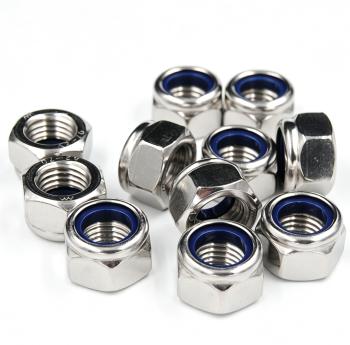
The nylon insert lock nut embeds a polymer nylon ring inside. Anti‑loosening effect is achieved through clamping friction generated when bolts screw into and squeeze the nylon insert. Featuring simple structure, convenient assembly and controllable cost, it is the most widely‑used cost‑effective anti‑loosening solution for general‑purpose machinery. Nevertheless, its anti‑loosening function relies on non‑metallic material, which is highly susceptible to temperature, aging and extrusion deformation, resulting in obvious performance limitations.
1.2 All‑Metal Self‑Locking Nut
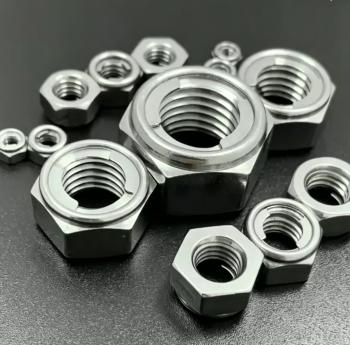
The all‑metal self‑locking nut adopts an integral metal structure. Mechanical self‑locking is realized via nut closing‑in, slotted elastic deformation and thread extrusion principles. Without any non‑metallic accessories, it keeps threads firmly engaged by the elastic tension of metal itself. It delivers outstanding advantages including high‑temperature resistance, fatigue resistance, vibration resistance, corrosion resistance and reusability. It is a high‑strength safety anti‑loosening solution for harsh industrial conditions.
2. Comprehensive Performance Comparison Table
|
Comparison Item |
Nylon Insert Lock Nut |
All-Metal Self-Locking Nut |
|
Locking Principle |
Nylon insert friction clamping locking (soft locking) |
Mechanical self-locking by metal elastic deformation and thread extrusion (hard locking) |
|
Temperature Resistance Range |
-40℃ ~ 80℃. Nylon softens and melts at excessive temperature, resulting in complete failure |
-60℃ ~ 300℃+. High temperature and welding residual heat resistant |
|
Vibration Resistance |
Only suitable for static and low-frequency vibration, easy to loosen under long-term high-frequency impact |
Excellent performance, suitable for continuous high-frequency vibration and dynamic loads of wind power and heavy industry equipment |
|
Corrosion & Aging Resistance |
Nylon is prone to UV aging, salt spray cracking and chemical corrosion failure |
Integral metal structure, resistant to salt spray, acid and alkali, and outdoor aging |
|
Repeated Disassembly Performance |
Poor performance. Permanent nylon deformation and severe torque attenuation after 2-3 disassembly and assembly cycles |
Excellent performance, supporting multiple disassembly and maintenance with high locking torque stability |
|
Load Grade |
Light-load, conventional equipment, non-structural stress points |
Heavy-load, structural stress-bearing, key safety connection points |
|
Anti-loosening Stability |
Stable in short-term service, unreliable in long-term working conditions |
Long-term stable performance with excellent fatigue resistance and no easy attenuation |
|
Purchase Cost |
Low cost with high cost performance |
Relatively high price, but lower comprehensive operation and maintenance cost |
3. Selection of Applicable Scenarios
✅ Applicable scenarios for nylon insert lock nuts
Only for general‑purpose mechanical equipment working indoors at normal temperature, without high temperature, heavy corrosion or continuous high‑frequency vibration, and requiring minimal disassembly and maintenance. Typical cases include ordinary electromechanical equipment housings, indoor cabinet accessories and light‑duty general assembly positions for conventional scenarios pursuing cost‑effective basic anti‑loosening performance.
✅ Applicable scenarios for all‑metal self‑locking nuts
Suitable for all harsh industrial conditions: wind‑power equipment, offshore engineering, marine facilities, port machinery, high‑temperature equipment, structures adjacent to welding joints, coastal salt‑spray‑exposed outdoor environments, high‑frequency vibration equipment, heavy‑load bearing structures, and high‑end engineering projects requiring regular overhaul and disassembly. It is the preferred anti‑loosening option for high‑end overseas procurement and safety‑critical engineering projects.
4. Common Industry
Selection Misunderstandings & Risk Avoidance
Misunderstanding 1: All stainless‑steel nuts deliver identical anti‑loosening performance
Many customers assume stainless‑steel nuts can be used universally, ignoring the temperature limitation of nylon components. Under high‑temperature conditions, nylon inserts will melt and fall off, completely losing anti‑loosening capacity and causing severe equipment safety risks.
Misunderstanding 2: Low‑cost selection reduces overall project expenditure
When nylon nuts are applied under harsh working conditions, loosening, falling‑off, equipment shutdown, rework and customer complaints are highly likely. Subsequent operation‑maintenance expenses, rework costs and project losses far exceed the price gap of fasteners.
Misunderstanding 3: Lock nuts can be reused infinitely
Nylon lock nuts are disposable anti‑loosening components with no reusability. All‑metal self‑locking nuts allow limited reuse and better fit industrial maintenance requirements.
5. Conclusion
The core of lock‑nut selection is not price comparison, but matching with working conditions. Cost‑effectiveness can be prioritized for ordinary scenarios, while stability and safety must come first for high‑end working conditions. Relying on its supporting manufacturer Jiaxing Aoke Hardware, Jiaxing Aoke Trading supplies high‑quality nylon insert lock nuts and stainless‑steel all‑metal self‑locking nuts in bulk. Custom service for various special lock nuts is available. Material traceability reports and mechanical‑property test certificates are provided for every batch, complying with strict audit standards of wind‑power, offshore and high‑end overseas projects. We deliver reliable fastener‑supply‑chain solutions for global clients.