Coarse Thread vs Fine Thread Bolts: How to Make the Right Selection
During fastener procurement and structural design, many overseas purchasing engineers struggle to choose between coarse thread bolts and fine thread bolts. The difference is not merely pitch variation. It directly affects connection strength, anti-loosening performance, assembly efficiency and service adaptability. Improper selection may cause loosening, thread stripping and assembly failure. Below is a detailed comparison of features, advantages and application scenarios for your quick reference.
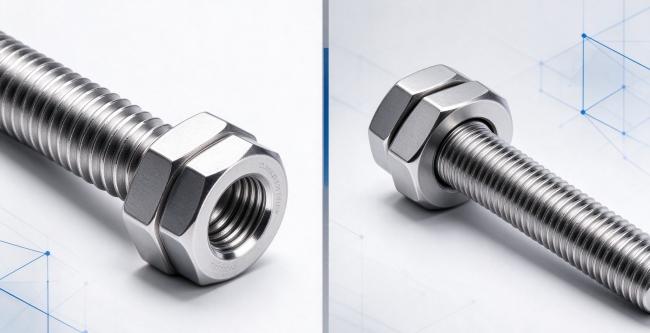
1. Coarse Thread Bolts (Standard Thread)
Coarse thread is the globally accepted baseline standard thread with a larger pitch, adopted as the primary specification in ISO, DIN, ANSI and other mainstream fastener standards.
Key Advantages
- High resistance to bumping; threads are not easy to be damaged, high tolerance for storage, transportation and on-site installation
- Fast assembly & disassembly, no strict requirement for tightening accuracy
- Great universality, matching nuts and washers are widely available with lower supply cost
Limitations: With the same nominal diameter, the minor diameter is smaller, leading to relatively lower tensile capacity; anti-loosening performance is weaker than fine thread.
Typical Applications: General mechanical joints, equipment frames, outdoor assembly, structures requiring frequent disassembly.
2. Fine Thread Bolts
Fine thread features smaller pitch and denser thread teeth on the shank. Multiple fine thread pitch series are available, and many non-standard fine thread sizes are manufactured against custom drawings.
Key Advantages
· Larger minor diameter for the same size, better tensile strength for heavy load & tension applications
· Smaller thread lead angle brings excellent self-locking performance, ideal for vibration conditions
· Fine adjustment capability, precise control of preload and clamping distance
Limitations: Shallow thread teeth, easy to strip when knocked; slower assembly and higher precision requirement
Typical Applications: Precision machinery assembly, high-pressure sealing joints, vibration-prone structures, fine adjustment needs, thin-wall component connection.
3. Core Selection Checklist
1. Load Type: Fine thread for heavy tensile load and alternating load; coarse thread for stable static load and frequent disassembly.
2. Working Environment: Fine thread for vibration and shock conditions; coarse thread for dusty, outdoor and rough field assembly.
3. Assembly Requirement: Fine thread for precise clamping adjustment, sealing and thin-wall joining; coarse thread for high assembly efficiency and universal spare parts.
4. Supply & Production: Coarse thread items are readily in stock with stable lead time; many fine thread sizes are non-standard and custom-made, so sample schedules need advance planning.
4. Summary
Coarse thread stands out for universal compatibility, impact resistance, fast assembly and easy spare part sourcing, suitable for most conventional industrial connections. Fine thread excels in higher tensile strength, natural self-locking and precision adjustment, targeting special scenarios including precision equipment, heavy load and vibration conditions. Neither option is universally superior. The optimal thread type should match your load condition, working environment and maintenance rules.
Jiaxing Aoke Hardware supplies standard coarse and fine thread bolts, as well as custom non-standard threaded fasteners. We can provide fastener selection support and reliability solutions according to your drawings, load data and working conditions. Contact us for samples and bulk orders.