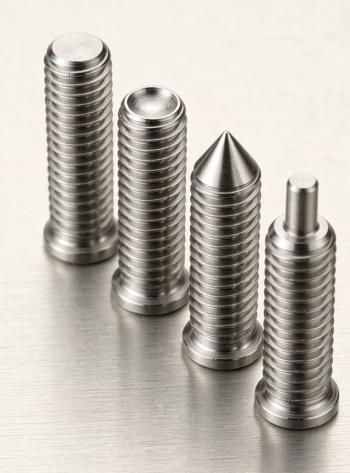
How Can Headless Set Screws Secure a Whole Machine?
Q1: What are the common point types of set screws and their differences?
A1: The main styles include cup point, flat point, cone point and dog point. Cup point delivers strong holding power for general shaft locking; flat point causes less surface damage for adjustable positioning; cone point bites deeply for permanent fixation; dog point fits pre-machined grooves for precise alignment.
Q2: Which material grade of set screw is suitable for high vibration working conditions?
A2: For vibration-prone equipment, choose 12.9 alloy steel or A4 stainless steel set screws. You can also pair with thread-locking adhesive. Soft carbon steel is easy to loosen under continuous vibration. Our team can recommend grades and surface treatments for your vibration loosening prevention solution.
Q3: Why do my set screws keep loosening after a short running time?
A3: Common reasons: insufficient tightening torque, wrong point style, mismatched hardness, lack of anti-loosening treatment or large cyclic vibration. Solutions include upgrading to higher-grade set screws, using thread locker, choosing cup point or adding a flat hardened pad on the contact surface.
Q4: What is a set screw, and how can a headless fastener lock an entire machine?
A4: A set screw (grub screw) is a fully threaded headless fastener. It does not rely on a head for clamping force. When tightened, its tip presses firmly against the shaft or mating component, generating friction and mechanical bite to lock gears, pulleys and hubs in place. It stops relative rotation and axial sliding, which is why it can stabilize the whole equipment assembly.
Q5: Can set screws be reused after disassembly?
A5: It depends on the condition. If the tip, thread and hex socket remain intact, reuse is acceptable. If the cup/cone tip has been deformed or indented deeply into the shaft, holding force will drop sharply, and replacement is recommended to avoid unexpected equipment loosening.
Q6: What common mistakes should buyers avoid when selecting set screws?
A6: Common mistakes: mismatched point style for the shaft surface, insufficient hardness, over-torque that crushes the shaft, or ignoring anti-loosening requirements for dynamic rotating parts. Improper selection will lead to shaft slipping, equipment downtime and extra maintenance cost.