How to Prevent Bolt Fatigue Fracture Under Vibration Conditions?
For equipment such as construction machinery, rail transit and wind power units under continuous cyclic vibration loads, bolt fracture is a common joint failure. Transverse slip caused by vibration gradually consumes bolt preload. Fatigue cracks initiate at stress-concentrated thread roots and expand continuously, which may lead to sudden fracture, equipment shutdown or safety hazards.
Vibration-related bolt failure is systematic rather than isolated, affected by structure selection, assembly procedure, preload control, heat treatment, surface protection and condition monitoring. Based on our field experience, we sorted out six engineering solutions covering selection, assembly and maintenance:
1. Adopt wedge-locking anti-loosening structure
Spiralock threads with a 30° wedge ramp are preferred. Unlike standard threads, spring lock washers or nylon insert nuts, this design converts radial slip force from vibration into steady axial tension. It removes thread clearance mechanically and withstands transverse excitation force, maintaining stable clamping force under long-term high-frequency vibration.
2. Precise preload control
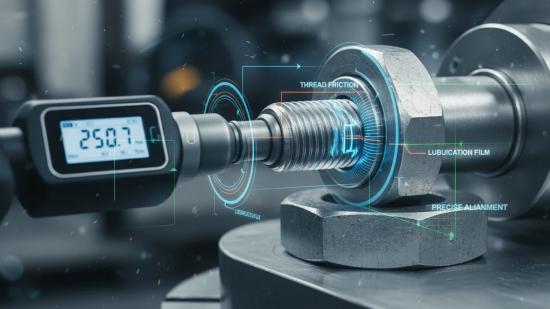
Traditional torque-only tightening is highly sensitive to thread friction and lubrication, which often leads to “false tightness”. We recommend electromagnetic dual-wave ultrasonic axial force inspection for 100% verification on critical bolts. Preload can be controlled steadily within the designed safe window (360~440kN), eliminating tension deviation caused by friction variation.
3. Standardize staged tightening process and lubrication
High-strength bolts must not be fully tightened in one step. Follow the 50%→75%→100% staged sequence to distribute clamping force evenly over the flange and prevent plate warping. Apply matched thread lubricant uniformly to stabilize torque coefficient K and achieve consistent preload across the bolt group.
4. Control heat treatment quality
Heat treatment dominates the fatigue performance of high-strength bolts. Heating, holding and cooling parameters are tightly controlled in production to avoid thread decarburization, preserve strength at thread roots and restrain fatigue crack initiation.
5. Select coating according to working environment
Ordinary zinc plating works for dry indoor conditions. Dacromet or zinc nickel coating is recommended for salt spray, humid and chemical environments. These coatings slow corrosion pit formation and mitigate hydrogen embrittlement, preventing accelerated fracture from combined corrosion and hydrogen risk.
6. Smart real-time monitoring system
For critical joints that cannot be shut down frequently, deploy sensor-integrated smart bolts for continuous axial force tracking. Alarms trigger once tension drops below the preset threshold (e.g. 360kN). Maintenance can be scheduled in advance before fatigue fracture, shifting from emergency breakdown repair to predictive maintenance and cutting unplanned downtime.
We help clients evaluate fastening solutions, select material grades and coatings according to vibration frequency, load amplitude, media and installation space, to mitigate bolt fatigue failure risks in vibration joint fastening applications.