How to Select Fasteners for Different Working Environments
In mechanical equipment, automotive manufacturing, construction, energy systems and industrial automation, screws and fasteners may be small components, but they play a critical role in connection stability, equipment safety and service life.
Different operating environments require different fastener specifications. Coastal applications face salt spray and moisture, high-temperature equipment requires heat-resistant materials, while machinery exposed to continuous vibration needs reliable anti-loosening solutions.
Choosing the wrong material or structural design may lead to thread corrosion, preload loss, loosening or even connection failure.
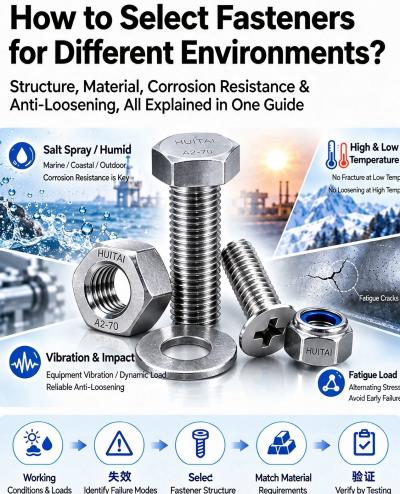
So, how do you select the right screws and fasteners for different working conditions?
1. Humid and Salt Spray Environments: Focus on Corrosion Resistance
Typical applications:
Marine equipment, port facilities, outdoor machinery, coastal construction and chemical processing equipment.
Long-term exposure to moisture, rainwater and salt spray can cause conventional carbon steel fasteners to corrode, affecting connection strength and maintenance.
Selection recommendations:
- 304 Stainless Steel: Offers good general corrosion resistance for humid environments and many outdoor applications.
- 316 Stainless Steel: Contains molybdenum and provides improved resistance to chloride-induced pitting, making it suitable for coastal and certain chemical environments.
- Zinc-Plated Carbon Steel Fasteners: Provide basic corrosion protection for less aggressive environments and cost-sensitive applications.
- Special Protective Coatings: Can be selected according to corrosion exposure, service life and application requirements.
2. High-Temperature Environments: Consider Heat Resistance and Strength Retention
Typical applications:
Engines, industrial furnaces, heat treatment equipment, exhaust systems and energy equipment.
High temperatures can affect mechanical properties and cause oxidation, creep, thermal expansion and changes in bolt preload.
Selection recommendations:
- Select heat-resistant stainless steel or nickel-based alloy fasteners according to operating temperature.
- For certain elevated-temperature applications, evaluate materials such as 310S and 304H.
- For more demanding temperatures or corrosive media, consider suitable nickel-based alloys.
- Evaluate thermal expansion differences between bolts, nuts and connected components.
3. Vibration and Impact Environments: Focus on Anti-Loosening Designs
Typical applications:
Automotive manufacturing, rail transportation, construction machinery, wind power and automated equipment.
Continuous vibration and dynamic loading may cause micro-slip in threaded connections, gradually reducing preload and potentially resulting in fastener loosening or connection failure.
Selection recommendations:
- Nylon Insert Lock Nuts: Use a nylon insert to increase resistance to thread rotation in suitable applications.
- All-Metal Lock Nuts: Suitable for applications requiring higher temperature resistance and reliable locking performance.
- Flange Bolts and Flange Nuts: Provide a larger bearing surface, with some designs incorporating serrations.
- Thread-Locking Adhesives: Select the appropriate strength grade according to service conditions and disassembly requirements.
- Other Mechanical Locking Solutions: Choose according to load conditions, installation space and maintenance requirements.
4. Cyclic Loading and Fatigue Environments: Focus on Strength and Structural Design
Typical applications:
Automotive chassis, construction machinery, industrial transmission systems and heavy mechanical structures.
Under repeated tensile, shear or dynamic loading, fasteners may develop fatigue cracks and eventually fail.
Selection recommendations:
- Select an appropriate property class based on load requirements.
- Consider bolt diameter, thread specifications and effective thread engagement length.
- Evaluate preload, joint stiffness and load distribution.
- Pay attention to stress concentration areas, including thread roots and head transitions.
- Conduct fatigue testing and application-specific validation when necessary.
5. Five Key Factors to Consider Before Purchasing Fasteners
- Operating Environment: Will the fasteners be exposed to salt spray, moisture, high temperatures, chemicals or outdoor conditions?
- Load Conditions: Will they withstand tensile forces, shear forces, impact or repeated cyclic loading?
- Structural Design: Are bolts, nuts, studs, self-tapping screws or customized fastening structures required?
- Material and Surface Treatment: Are specific material grades, property classes or corrosion protection requirements needed?
- Testing Requirements: Are salt spray, tensile, hardness, torque or vibration tests required?
For international buyers, fastener procurement involves more than product pricing. Material consistency, quality control, delivery reliability and customized manufacturing capabilities are equally important.
Looking for the right screws or fasteners for your specific operating environment?
Contact us with your drawings, material requirements, application conditions or purchasing specifications. Our team can help evaluate suitable materials, structural designs and sourcing solutions for your project.