Low-Carbon Advantage of 316L|M20 316L Flex Lock Nut Solves Corrosion Risks for Harsh-Condition Fastening
In industrial assembly scenarios involving welding, high-temperature operation and coastal salt-spray erosion, conventional 316 stainless-steel industrial fasteners are exposed to unavoidable sensitization risks. When subjected to welding and thermal cycling, carbon elements precipitate chromium carbide along grain boundaries, depleting surface chromium protection. This triggers intergranular corrosion and micro-cracks. Combined with long-term vibration, fasteners will loosen prematurely, resulting in frequent equipment maintenance and hidden structural safety hazards.
To fully address sensitization failure and intergranular corrosion triggered by welding heat, salt spray and humid harsh environments, Jiaxing Aoke Trading Co., Ltd., together with its supporting manufacturer Jiaxing Aoke Hardware, presents the heavy-duty premium M20 316L Flex Lock Nut. Marked by the letter “L” for low-carbon grade, its carbon content is strictly limited to ≤0.03%. Compared with standard 316 stainless steel, the ultra-low-carbon composition fundamentally inhibits chromium carbide precipitation at grain boundaries during welding and thermal processing and prevents material sensitization and post-weld corrosion cracks. Even after repeated high-temperature heat treatment, welding forming and long-term service in harsh surroundings, 316L retains full, stable corrosion resistance. It remedies the inherent weakness of conventional 316, whose anti-corrosion performance degrades significantly under thermal exposure, and acts as an irreplaceable high-end fastening option for heavy-duty corrosive working conditions.
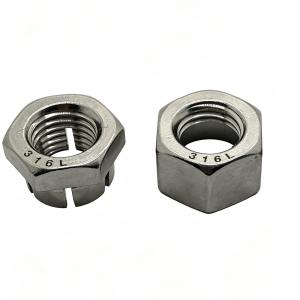
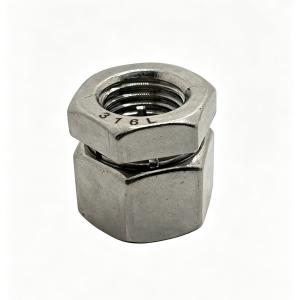
Core Advantages of M20 316L Flex Lock Nut
1.Low-carbon material advantage against intergranular corrosion
The 316L low-carbon base material restrains chromium carbide precipitation after welding and high-temperature treatment. It avoids material sensitization, and maintains complete corrosion-resistance performance even after thermal processing. Unlike ordinary 316, it will not form corrosion weak points at grain boundaries, greatly extending service life for welded assemblies deployed in corrosive surroundings.
2.Heavy-duty M20 large-size mechanical performance
Benefiting from larger load-bearing cross-section, M20 can bear high-magnitude axial preload and shear force. It meets the strength requirements for main-structure heavy-load joints. Small-size nuts are prone to yield deformation under heavy load, while M20 delivers stable mechanical strength for long-term static and dynamic load conditions, and cannot be simply replaced by smaller-dimension fasteners.
3.All-metal reliable self-locking performance
Adopting radial slotted elastic locking structure without nylon inserts or other aging-prone non-metallic parts. It eliminates failure risks such as nylon ageing at high temperature and medium swelling. Sustained elastic clamping force is maintained under continuous reciprocating vibration and alternating shock loads. Self-locking function will not fail even under temperature fluctuation or chemical medium immersion.
4.Multi-factor complex-condition comprehensive adaptability
Integrates anti-intergranular-corrosion property, heavy-load mechanical strength and all-metal vibration-proof capacity. It copes with superposed working conditions including welding thermal impact, heavy static load, cyclic vibration, salt-fog and chemical corrosion. One single fastener solves multiple failure risks simultaneously, reducing the procurement of different spare-part models and lowering overall project maintenance cost.
5.Controllable manufacturing & customized support
Manufactured by our partner factory Jiaxing Aoke Hardware. Thread accuracy, hardness and surface finish are strictly controlled. Besides standard M20 316L Flex Lock Nut, custom modifications on dimension, thread and surface treatment are available to match project-specific requirements.
Beyond the material-driven low-carbon corrosion-resistant benefits, M20 is a heavy-duty large-size variant. Its enlarged load-bearing cross-section enables it to sustain higher axial preload and shear force. It is designed for critical main load-bearing joints, such as equipment main frames, load-bearing supports and flange connections. Under heavy-load circumstances, smaller-sized nuts face risks of insufficient bearing capacity and yield deformation; therefore, M20 cannot be simply substituted by medium or small-dimension fasteners.
This all-metal self-locking nut features a radial slotted elastic locking structure with no nylon inserts or other non-metallic components prone to ageing. It eliminates failure modes including high-temperature nylon ageing and medium-induced swelling, and maintains consistent, reliable mechanical self-locking clamping force under continuous reciprocating vibration and alternating shock loads. Integrating excellent intergranular-corrosion resistance and heavy-duty high-durability fastening capability, the 316L low-carbon Flex Lock Nut is purpose-built for high-standard industrial projects that demand long-term anti-loosening performance as well as resistance to welding thermal impact and severe corrosion.
Applicable Industries & Typical Working Conditions
- Target industries: offshore engineering facilities, marine platform attachments, chemical pressure vessels, heavy-duty complete chemical equipment, coastal port cranes, wind-power auxiliary units, thermal-power facilities, rail-transit assemblies and outdoor heavy-duty construction machinery.The large-size M20 is deployed on core heavy-load connection points including main equipment frames, load-bearing supports and flange joints.
- Offshore & marine engineering: Suitable for bolted connections of offshore platform auxiliary supports, seawater pipeline flanges, deck-mounted equipment bases and offshore module frames. These positions face persistent seawater splashing, salt-fog erosion, wave-induced cyclic vibration, and local welding operations during on-site installation. Ordinary fasteners easily suffer intergranular corrosion and loosening, while M20 316L Flex Lock Nut delivers stable long-term fastening reliability.
- Chemical industry: Applied to heavy-duty joints of chemical pressure vessels, reaction tank brackets, pipeline flange assemblies and chemical processing skids. Working media include acid-alkali vapors and corrosive liquids. Many structural parts require welding fabrication; the low-carbon property avoids post-weld corrosion, and large-specification mechanical strength satisfies the safety requirements for pressure-bearing equipment.
- Coastal port machinery: Used for main frame connections of port cranes, container handling equipment and shore-based auxiliary structures. Exposed to coastal salt-spray environment all year round, devices bear frequent start-stop impact and mechanical vibration. It prevents fastening failure which may lead to costly equipment downtime.
- New-energy & thermal power: Fits wind-power auxiliary module supports, heat-exchanger flanges, thermal power unit auxiliary frames and exhaust-gas treatment equipment. Components go through welding, thermal cycling and outdoor atmospheric corrosion. Heavy-load M20 size copes with static weight and running vibration simultaneously.
- Rail transit & heavy-duty machinery: Deployed on vehicle-body auxiliary supports, under-frame mounting points of rail-transit assemblies, as well as chassis and large-welded bracket connections for outdoor construction machinery. It handles alternating shock loads, while resisting corrosion from humid outdoor atmosphere.
These joints endure substantial static pre-tightening force and alternating impact loads, while being exposed to multiple overlapping adverse factors: welding thermal influence, persistent high-frequency vibration, marine salt fog and chemical-medium erosion. Limited by cross-section size, ordinary medium- and small-size nuts struggle to balance load-bearing capacity, anti-loosening performance and corrosion resistance. Faced with such complex coupled conditions, the M20 316L Flex Lock Nut mitigates three major risks at once: post-weld intergranular corrosion, vibration-caused loosening and heavy-load yielding. It stands as the preferred high-reliability fastener for long-term stable operation of heavy-industrial projects.