Why Is One T-Bolt Always Loose When Installing Aluminum Profiles?
T-bolts are widely used in aluminum extrusion systems, industrial automation equipment, machinery frames, and modular structures. They are designed to fit directly into T-slots, providing flexible positioning, convenient installation, and easy adjustment without additional drilling.
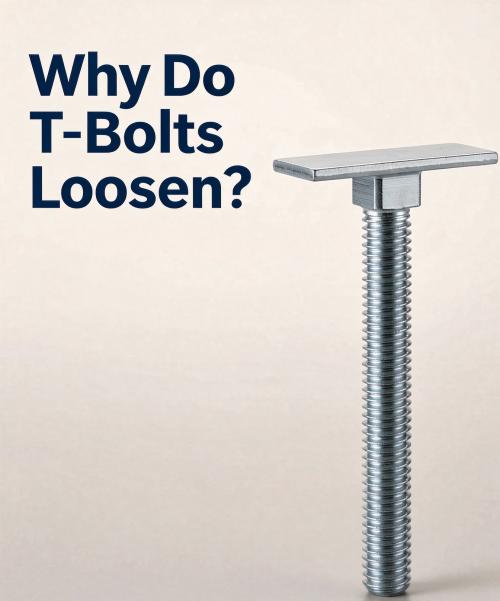
However, during actual assembly, engineers and installers sometimes encounter a frustrating problem: several T-bolts can be tightened properly, but one bolt remains loose, moves inside the slot, or fails to provide sufficient clamping force.
In fact, fastening performance depends not only on the T-bolt itself but also on slot dimensions, head design, thread compatibility, and assembly procedures.
Here are six common causes and their corresponding solutions.
1. The T-Bolt Is Not Properly Positioned
T-bolts are designed to engage with the internal structure of aluminum profile T-slots. If the bolt head does not reach the correct locking position, insufficient contact may occur.
Common problems include:
- Incomplete engagement between the bolt head and slot.
- Insufficient contact with the internal slot surfaces.
- Bolt rotation or displacement during tightening.
- Reduced clamping force and connection stability.
Solution: Check the bolt head orientation and ensure that it is correctly positioned inside the T-slot before tightening.
2. Mismatched T-Slot Dimensions
Different aluminum extrusion profiles have different slot widths, depths, and internal geometries.
Even when two T-bolts have the same thread specification, their head dimensions may not be compatible with every aluminum profile.
Common issues include:
- Slots that are too wide for the bolt head.
- Slots that are too narrow for proper installation.
- Dimensional variations between different profile batches.
Solution: Confirm the aluminum profile specifications before purchasing T-bolts. Check the head width, thickness, and overall dimensions to ensure proper compatibility.
3. Improper T-Bolt Head Design
The bolt head plays a critical role in mechanical engagement and load distribution.
If the head dimensions or design are unsuitable, the fastening connection may experience insufficient contact area, concentrated stress, or displacement under vibration.
Solution: Select T-bolts with suitable head dimensions and structural designs according to the aluminum profile and actual load requirements.
4. Uneven Load Distribution Between Multiple Bolts
When installing brackets, mounting plates, or aluminum frame structures, an improper tightening sequence may result in uneven load distribution.
If several bolts are fully tightened first, the connecting plate may become slightly misaligned, preventing the remaining bolts from making proper contact.
Solution:
- Tighten bolts gradually using a crosswise or alternating sequence where appropriate.
- Apply tightening force in stages.
- Check the flatness and alignment of connecting plates.
- Follow the specified tightening torque requirements.
5. Thread Compatibility and Manufacturing Accuracy Issues
Thread quality is another important factor affecting fastening performance.
Dimensional deviations, damaged threads, or poor compatibility between bolts and nuts may cause tightening difficulties, thread stripping, or insufficient preload.
Solution:
- Verify thread specifications and tolerances.
- Ensure smooth thread engagement.
- Inspect threads for surface damage.
- Perform dimensional inspections on critical components.
6. Operating Conditions Affect Fastening Stability
In industrial machinery and automation equipment, continuous vibration, impact loads, and temperature fluctuations may affect fastening stability.
Without an appropriate fastening solution, bolts may gradually loosen during long-term operation.
Solution: Select suitable materials, bolt structures, and anti-loosening measures based on operating conditions, vibration levels, and load requirements.
What Should Buyers Consider When Purchasing T-Bolts?
For international buyers, selecting T-bolts involves more than comparing prices and thread sizes. Product compatibility and application requirements are equally important.
Key purchasing considerations include:
- Material Selection: Choose carbon steel, stainless steel, or other suitable materials according to the operating environment.
- Dimensional Accuracy: Ensure that head dimensions, thread specifications, and overall measurements meet drawing requirements.
- Surface Treatment: Select appropriate coatings or surface treatments according to corrosion protection requirements.
- Mechanical Performance: Verify that the fasteners meet the required load and fastening conditions.
- Quality Consistency: Pay attention to dimensional stability and manufacturing consistency across production batches.
Conclusion: Reliable Fastening Starts with the Right Selection
Although T-bolts are relatively small components, they play an important role in the stability of aluminum extrusion frames and industrial equipment.
When one bolt remains loose during installation, the problem may not necessarily indicate a defective fastener. It could also result from slot dimensions, dimensional incompatibility, or improper assembly procedures.
For fastener distributors, equipment manufacturers, and industrial buyers, selecting accurately manufactured and application-compatible T-bolts is essential for improving assembly efficiency and connection reliability.