Why Machinery Prefers Socket Head Cap Screws While Auto Parts Use Hex Head Bolts
In industrial manufacturing, fasteners may appear to be small and simple components, but they play a critical role in equipment performance, structural stability, and assembly efficiency.
If you look closely at industrial machinery and automotive applications, you may notice an interesting difference: socket head cap screws are commonly found in machinery, while hex head bolts are frequently used in automotive assemblies.
Why does this happen?The answer lies in installation space, torque requirements, assembly efficiency, accessibility, and manufacturing costs. Understanding these differences can help engineers and purchasing professionals select the right fasteners for their applications.
1. Why Are Socket Head Cap Screws Popular in Machinery?
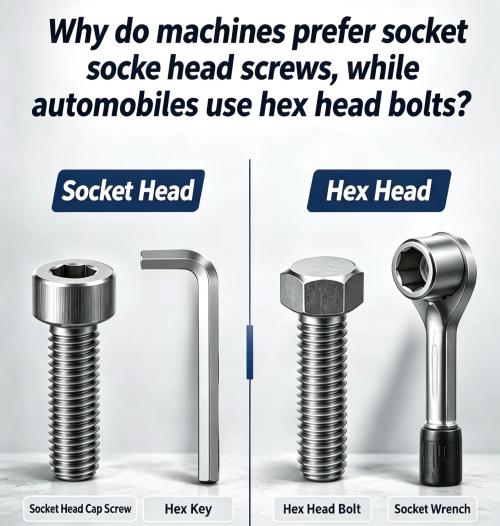
Socket head cap screws feature a cylindrical head with an internal hexagonal drive, allowing installation with an Allen key or hex bit.
They are particularly suitable for industrial machinery, automation equipment, precision instruments, and mechanical assemblies.
Key advantages:
1. Space-Saving Design
2. High Clamping Force
3. Recessed Head Design
4. Suitable for Precision Machinery
2. Why Are Hex Head Bolts Commonly Used in Automotive Applications?
Hex head bolts feature an external hexagonal head that can be tightened using open-end wrenches, ring spanners, or sockets.
They are widely used in automotive structures, chassis assemblies, engine components, and other mechanical connections.
Key advantages:
1. Easy Installation and Removal
2. Compatible with Automated Assembly
3. Convenient Maintenance
4. Versatile Applications
3. Socket Head vs. Hex Head: What Are the Main Differences?
Choosing between socket head cap screws and hex head bolts depends on the specific application and engineering requirements.
Comparison
Socket Head Cap Screws
Hex Head Bolts
Head design
Cylindrical head
External hexagonal head
Drive type
Internal hex
External hex
Installation space
Suitable for compact spaces
Requires tool access around the head
Installation tools
Allen key / Hex bit
Wrench / Socket
Typical advantages
Compact design and recessed installation
Accessibility and convenient maintenance
Common applications
Machinery, molds, automation equipment
Automotive assemblies, chassis, structural connections
4. What Should Buyers Consider When Selecting Industrial Fasteners?
For overseas buyers, selecting fasteners involves more than comparing dimensions and unit prices. Several factors should be evaluated before placing an order.
1. Material Selection
Different working environments require different materials.
- Carbon steel: Suitable for many general industrial applications.
- Stainless steel: Offers corrosion resistance for demanding environments.
- Alloy steel: Suitable for applications requiring higher mechanical strength.
- Special alloys: Designed for specific high-temperature, corrosive, or demanding service conditions.
2. Strength Grade and Mechanical Performance
3. Surface Treatment and Corrosion Resistance
4. Dimensional Accuracy and Quality Control
5. Supplier Capability and Delivery Reliability
Looking for a reliable fastener sourcing partner in China?
At Aoke, we understand that different industries have different fastening requirements.As a fastener trading and sourcing partner, we provide solutions covering standard fasteners, customized non-standard fasteners, stamping parts, and sourcing services.
Send us your drawings, specifications, or product requirements. Our team will help you explore suitable sourcing and manufacturing solutions.