How to Avoid Thread Galling for Flange Joints under High-Temperature Corrosion? A193-B7 + 2H Nut PTFE-Coated Fastener Kit
In heavy industries such as petroleum, chemical, power plants, and pressure vessels, the flange connections of high-temperature and high-pressure pipelines are the core critical components for equipment operation, as well as the weak links that are most prone to failures and increase operation and maintenance costs. Based on our practical experience in undertaking overseas projects in Southeast Asian countries including Vietnam, the on-site high-frequency failure issues are concentrated and typical, which can be specifically divided into three categories:
- Working condition corrosion issues: In the coastal areas of Southeast Asia, where high temperature, high humidity and high salt spray persist all year round, after long-term service of ordinary fasteners, their threads are extremely prone to corrosion, rusting, oxidation and aging, which directly leads to loose flange seals and leakage of equipment media, thus affecting the normal operation of the production line.
- The problem of thread seizing: Under sustained high-temperature and high-pressure pressure-bearing conditions, cold welding and galling easily occur between the threads of studs and nuts, making normal disassembly impossible during equipment maintenance, which can only be removed through destructive methods such as cutting and grinding.
- Surge in Operation and Maintenance Costs: Destructive disassembly will directly scrap the entire set of fasteners, and even damage the flange sealing surface, triggering a series of high operation and maintenance losses such as equipment downtime, construction period delays, and spare parts replacement, which is a major pain point for overseas heavy industry projects.
The core issue that plagues equipment operation and maintenance personnel the most is thread seizure (also known as thread cold welding or galling). This situation has been encountered at many project sites: when equipment reaches its maintenance cycle, the flange fasteners cannot be disassembled normally at all, with the threads tightly locked together, so they can only be removed by destructive methods such as cutting and grinding. This not only directly scraps the entire bolt assembly, but also damages the flange sealing surface, leading to equipment downtime, construction period delays, and high maintenance costs, which seriously undermines the stable operation of the production line.
After reviewing and summarizing multiple projects, such flange failures are not caused by equipment operating conditions exceeding the standard, and the core reasons lie in the misunderstandings in industry selection and matching, which are also the key points where most purchasers are prone to fall into pitfalls:
- Mismatched material combination: Most purchasers separately procure A193-B7 high-temperature and high-strength studs, and arbitrarily pair them with plain carbon steel or low-strength nuts. A193-B7 is a quenched and tempered chromium-molybdenum alloy steel featuring high temperature resistance, creep resistance and high strength, while the hardness, tensile strength and heat resistance of ordinary nuts cannot match those of the studs.
- Mechanical structure imbalance: When strong and weak materials are mixed for operation, problems such as uneven stress, rapid attenuation of high-temperature pre-tightening force, and thread deformation will occur, which can easily lead to potential safety hazards such as flange loosening, medium leakage, and pipe burst after long-term use.
- Non-standard collocation is non-compliant: it fails to meet ASTM industry standards. High-strength flange fasteners must be matched as a complete set, and arbitrary mixing and matching of studs, nuts and washers is strictly prohibited.
Under long-term high-temperature and pressure-bearing operation, the mixing of strong and weak materials will lead to problems such as uneven stress, rapid attenuation of pre-tightening force, and deformation of thread clearance, which can easily trigger potential safety hazards including flange loosening, leakage and pipe burst. In compliance with the authoritative ASTM industry standards, A193-B7 fully threaded studs must be paired with A194-2H heavy hex nuts and GB97 standard flat washers; the mechanical parameters of the entire assembly are fully matched, with balanced stress and stable pressure bearing, thus avoiding flange connection failures from the root of component selection.
The main bulk production sample for this export engineering project to Vietnam is the A193-B7 full-thread stud assembly in the specification of M24*300, which is a heavy-duty specification exclusively customized for this project. The detailed product specifications and parameters are as follows:
1.Complete product configuration: A193-B7 fully threaded studs + A194-2H heavy hex nuts + GB97 standard flat washers, supplied as a fully matched integrated set with no mismatched components.
2.Specific specifications and dimensions: Stud specification M24×300mm, with a full-thread continuous tooth design, suitable for the assembly requirements of high-pressure flange through holes.
3.Material execution standards:
Studs: ASTM A193 Gr. B7 (quenched and tempered chromium-molybdenum alloy steel);
Nuts: ASTM A194 Gr.2H heavy-duty grade;
Gaskets: GB97 national standard.
4.Surface treatment process: integrated blue PTFE Teflon coating, which is different from ordinary galvanizing and Dacromet processes, and is suitable for high-temperature and corrosive working conditions.
5.Protective packaging configuration: Standard-equipped blue mesh threaded protective sleeve, which fully protects the thread profile and eliminates wear and collision during ocean shipping.
6.Operating condition parameters: Suitable for high-temperature, high-pressure, and salt spray corrosion conditions, and is widely used in flange connections of petroleum, chemical, power plant, and pressure vessel pipelines.
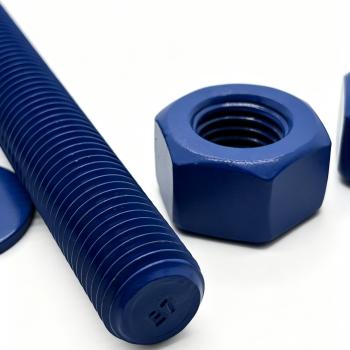
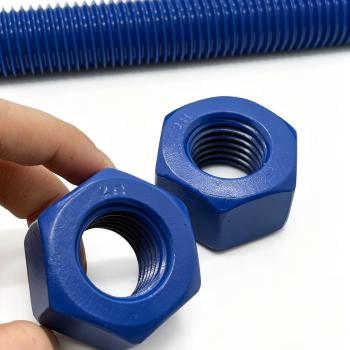
The entire product line strictly complies with the dual standards of ASTM and national standards, and is designed to address the pain points of harsh working conditions in Southeast Asia in a targeted manner. Its core advantages are as follows:
- Superior corrosion resistance, ideal for coastal working conditions: Compared with traditional hot-dip galvanizing, blackening and ordinary Dacromet processes, the PTFE coating delivers significantly enhanced acid and alkali resistance, salt spray resistance and high temperature resistance, which can long-lastingly withstand the hot and humid corrosive environment in Southeast Asia and delay the aging and rusting of threads.
- Prevent thread seizure and reduce operation and maintenance difficulty: it effectively lowers the thread engagement friction coefficient, fundamentally solves the problems of thread cold welding and seizure under high-temperature working conditions, makes later equipment maintenance, assembly and disassembly smoother, eliminates the need for destructive removal, and significantly cuts operation and maintenance costs.
- Complete mechanical matching ensures more stable operation: The complete set consisting of A193-B7 studs, A194-2H heavy-duty nuts and GB97 gaskets features uniform force bearing and stable pressure resistance, thoroughly eliminating the risks of sealing failure, loosening and leakage caused by mismatched combinations.
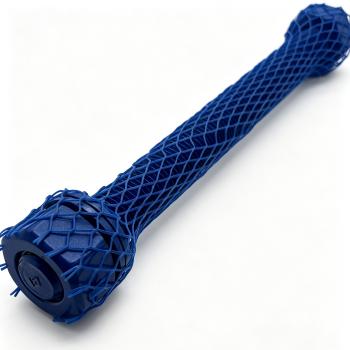
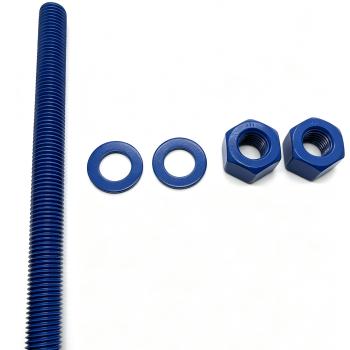
To address the pain points of long-distance overseas sea freight delivery, we have launched exclusive refined protection upgrades to ensure that goods arrive at the port intact, with our delivery advantages clearly evident:
- Exclusive thread protection design: All products are uniformly fitted with blue thread protection mesh sleeves before leaving the factory, which fully cover the thread profile to precisely protect the precision thread structure.
- Full-process loss prevention and protection: It can effectively avoid collisions, scratches and abrasions during ocean shipping, loading and unloading, and warehousing and transshipment, so as to fully retain the original precision of the threads.
- Ready-to-use delivery: eliminates assembly failures, rework and replacement issues caused by transportation damage, and the goods can be directly assembled on the machine upon arrival at the Vietnam construction site without delaying the project schedule.
Leveraging the advantages of Jiaxing Aoke Hardware's Localization supporting production, we are fully capable of undertaking the complete delivery business of A193-B7 series flange fasteners, and our supply capacity is fully adapted to the needs of overseas projects:
- Spot Goods for Fast Delivery: We maintain year-round stock of mainstream specifications commonly used in overseas projects such as M24*300, support fast order scheduling and shipment, and cater to the needs of urgent projects.
- Non-standard Customization Service: We can customize various non-standard length, special coating and high-precision fastener assemblies according to customers' equipment drawings, on-site working conditions and project acceptance standards.
- Whole-process quality inspection guarantee: the products go through multiple procedures including dimension verification, hardness testing, coating thickness detection and appearance screening before delivery, and MTR material reports and quality inspection certificates can be provided for each batch, which meet the acceptance standards of various heavy industry export projects.
- Flexible batch delivery: It supports small-batch sample testing and full-container bulk export, and adapts to various delivery scenarios for overseas engineering projects in Vietnam and Southeast Asia.