Why Grade 12.9 Bolts Are Prone to Unexpected Fracture?
Many procurement engineers hold a common misunderstanding: the higher the performance grade of a bolt, the higher its safety factor. When facing heavy-load and vibration working conditions, their first choice is Grade 12.9 bolts. However, in real industrial service, simply upgrading bolt grades for safety margin may lead to sudden, unforeseen bolt fracture failures.
As a supplier specializing in the reliability engineering and anti loosening technology of fasteners, today we break down the core logic that is easily overlooked in material mechanics: high strength ≠ high safety, and the cost of strength improvement is the loss of toughness.
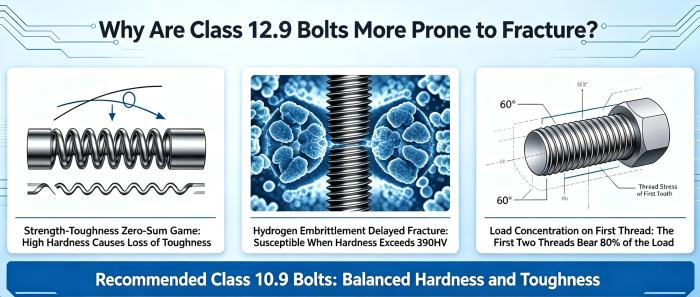
Zero-sum Game of Strength: Loss of Toughness Triggering Brittle Fracture
High strength does not equal high safety. When steel is heat-treated to meet Grade 12.9 standards with hardness ranging from 385–435HV, its tensile strength rises while the elongation (A) and low-temperature impact toughness (KV) decrease irreversibly.
Fasteners work like springs. They generate preload through elastic deformation to clamp workpieces. When equipment endures long-term alternating loads and shock vibration, Grade 12.9 bolts lack sufficient plastic deformation buffer zones. Stress concentrates at the thread root, which easily causes sudden brittle fracture. In comparison, Grade 10.9 bolts retain better elongation and toughness to absorb vibration stress, delivering superior system robustness under dynamic working conditions.
Hidden Risk: Grade 12.9 Bolts Are Highly Susceptible to Hydrogen Embrittlement Failure
Steel’s sensitivity to hydrogen embrittlement rises sharply when hardness exceeds 320HV, and Grade 12.9 bolts cross this critical threshold. Pickling, electroplating and other surface treatment processes, or humid salt-spray environments allow hydrogen atoms to penetrate the metal matrix. Under continuous preload tension, hydrogen atoms accumulate at stress concentration points, damaging metal grain boundaries and resulting in delayed fracture.
The bolt may look intact after installation but breaks suddenly days or weeks later. Such failures are hard to diagnose and may cause equipment shutdown or safety incidents.
Practical Advice for Fastener Selection.
1. Do not select bolts merely based on strength; distinguish static loads from alternating shock loads.
2. For dynamic scenarios with vibration and impact, prioritize Grade 10.9 bolts to balance strength and toughness.
3. If Grade 12.9 bolts are mandatory for your project, de-hydrogen baking must be applied after surface treatment to control hydrogen embrittlement risks.
4. Send us your working condition parameters to receive professional fastener selection support.
Jiaxing Aoke Trading supplies standard high-strength fasteners and custom non-standard bolts. Supported by our partner plant’s mature quality control system for heat treatment and surface finishing, we match fastener grades according to clients’ real working conditions and avoid fracture hazards caused by improper material selection.