How to solve soft connection torque decay on automotive damping pad joints?
In automotive front cowl assembly, axial interference often occurs between body welded studs and damping pads. Non-metallic damping pads are accidentally squeezed between sheet metal substrate and studs, forming a typical soft connection structure. Torque inspection passes at the initial assembly stage. However, due to stress relaxation and creep characteristics of non-metallic materials, coupled with vehicle vibration and temperature cyclic load during driving, bolt preload continuously declines, resulting in loose joints, sealing failure, front cowl abnormal noise and wind leakage, which damages automotive NVH performance.
1. Case & Test Data
We carried out multiple groups of comparative bench durability tests for a front cowl damping pad assembly project under axial damping pad interference condition to quantify the preload retention capacity of different nuts:
- Test condition: 1000h combined high-low temperature cycling & vibration durability test, simulating long-term vehicle service, monitoring torque and residual preload changes synchronously;
- Ordinary nut group: After test, the maximum bolt preload attenuation reached 42%. Micro-slip appeared on joints, and disassembly inspection showed irreversible creep compression of damping pads, residual clamping load of thread pairs below the design lower limit;
- Nylon lock nut group: Under identical test conditions, nylon ring aged under high temperature, maximum preload attenuation reached 35%, anti-loosening performance decreased sharply under high temperature;
- Aoke Anti-loosening Nut group: Under identical test conditions, residual preload retention rate stably maintained ≥88%, no thread rotation and loosening. It effectively offsets preload loss caused by damping pad creep;
- Real vehicle road test: Vehicles equipped with Aoke anti-loosening nuts showed no thread rotation after disassembly, no abnormal noise or wind leakage after 12000km road test.
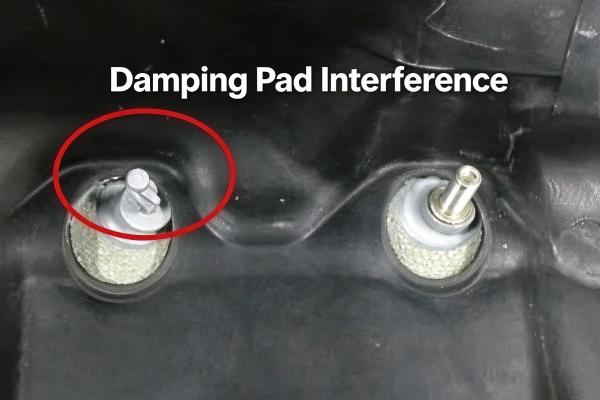
Comparative tests prove that ordinary nuts, spring washers and nylon lock nuts cannot cope with creep failure of soft connections with non-metallic interlayers. With wedge thread structure, Aoke anti-loosening nuts do not rely on contact friction and are suitable for interlayer conditions with creep-prone damping pads.
2. Root Mechanism of Soft Connection Failure
- Stress Relaxation Under constant strain, molecular chains of polymer damping pads slide and rearrange under compression, stored elastic energy dissipates continuously, and clamping force slowly drops over time. Preload loss occurs even under static conditions without external vibration.
- Creep Deformation Sustained bolt preload pressure causes irreversible plastic compression of damping pads and gradual thickness reduction. The elastic elongation of bolts decreases, directly reducing preload, which is the core cause of long-term soft connection failure.
- Dynamic loads accelerate attenuation Multiple loads including engine vibration, road impact and temperature cycles are superimposed during vehicle operation. Vibration causes micro-slip of thread pairs; the mismatch of thermal expansion coefficient between metal studs and non-metallic damping pads generates extra thermal stress. Under combined effects, preload drops non-linearly and rapidly.
Traditional anti-loosening solutions (spring washers, standard nylon lock nuts) rely on friction locking. Once the damping pad interlayer creeps and becomes thinner, contact pressure drops quickly and friction locking fails, making it impossible to maintain stable clamping load for a long time.
3. Core Technical Advantages of Aoke Anti-loosening Nut
- 30° wedge thread mechanical locking
- All-metal structure, excellent vibration & temperature resistance
- Reusable and compatible with standard bolts
- Wide application in automotive soft interlayer joints
4. Integrated Supporting Supply Chain Service
With our professional fastener technology and cooperating stamping factory Jiaxing Aoke Hardware, we provide comprehensive supply chain service from early risk assessment to delivery control:
✅ Evaluate assembly interference risk of damping pads and stamped sheet metal at DFMEA stage, predict hidden creep failure risks;
✅ Recommend suitable fastener solutions including Aoke anti-loosening nuts according to interlayer material parameters, ambient temperature and vibration load;
✅ Support bench tests for creep, transverse vibration and preload decay to verify reliability in advance and avoid batch quality accidents in mass production;
✅ Flexible sourcing of stamped parts and fasteners, unified control of dimensional tolerance to reduce assembly interference probability;
✅ Conduct process review in mass production, provide tightening process suggestions, stabilize mass delivery quality and offer assembly technical training synchronously.
Soft connection failure is not a single fastener quality issue, but a systematic engineering problem caused by combined effects of interlayer material creep, assembly interference and dynamic loads. With wedge thread design, Aoke anti-loosening nuts break the traditional friction anti-loosening principle and resist preload decay under creep working conditions by mechanical locking. We do not merely supply fasteners, but deliver integrated technical service including product selection, risk prediction and test verification.